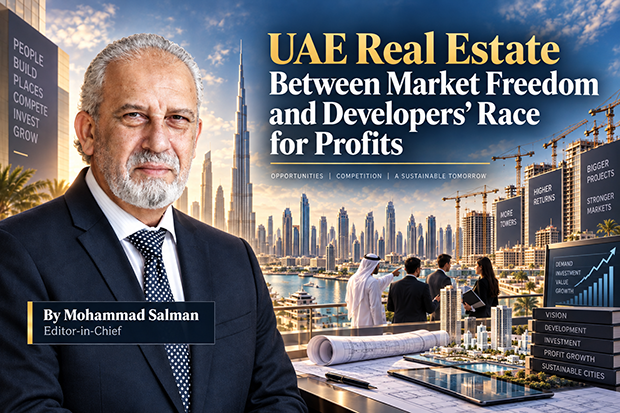
By Mohammad Salman, Editor-in-Chief
The UAE has succeeded over the past years in building one of the most active and attractive real estate markets in the world. Regulations have evolved, registration procedures have become easier, foreign investment has expanded, and investor confidence has grown significantly.
In Dubai alone, the value of real estate transactions in the first quarter of 2026 reached around AED 252 billion, up 31% year on year, according to the Dubai Land Department. That figure reflects the strength of the market, the scale of liquidity, and the confidence the emirate has managed to attract.
Abu Dhabi has also seen strong activity. Off-plan sales accounted for around 89% of residential sales value in the first half of 2026, within a market that recorded significant growth in transaction volumes.
These achievements did not happen by chance.
The government has largely done its part by creating a strong legal framework, world-class infrastructure, investor-friendly procedures, registration systems, and escrow mechanisms for off-plan developments. In Dubai, developers must meet specific regulatory requirements before registering and selling an off-plan project.
But once that foundation is in place, responsibility shifts to another party.
The developer.
And this is where an important question must be asked:
Is strong demand today enough reason to keep launching projects without limits?
Or does protecting the market require developers to think seriously about what could happen tomorrow?
Market freedom does not mean ignoring risk
Real estate is ultimately an open market driven by supply and demand.
No one can deny a developer the right to launch a new project when there is a genuine commercial opportunity.
But economic freedom does not mean freedom from responsibility.
A developer selling thousands of off-plan units is not simply dealing with numbers on a sales sheet. It is dealing with the savings of investors and families who may have committed a large share of their capital to a property they will not receive for several years.
That means the responsibility goes beyond making the sale.
The real obligation is being able to complete the project even if market conditions change.
The race to launch more projects
During the strong upswing in the market, we have seen a high volume of launches.
In many cases, projects look remarkably similar: similar concepts, similar amenities, similar payment plans, and even similar marketing language.
Everyone wants a share of the current demand.
From a commercial perspective, that is understandable.
But the real question is what happens if supply continues rising while demand slows.
In early 2026, new launches in Dubai were being absorbed rapidly, but the pace later eased amid higher regional risks and shifting buyer sentiment.
The market has already shown how quickly external events can affect sales. Reports in September noted that one developer experienced a sharp decline in sales during a period of regional tension before recovering much of that ground later.
That matters.
The market is strong, but it is not isolated from the rest of the world.
War, financial stress, higher interest rates, disruptions to aviation or trade, or a sudden change in investor confidence can all affect the decision to buy a property worth one million, five million, or twenty million dirhams.
The real problem is not simply the number of projects
A developer may say: if buyers are there, why should I not sell?
That argument is valid to a point.
The danger begins when growth plans are built on the assumption that today’s demand will continue at the same pace for years.
Real estate is cyclical by nature.
It rises.
It slows.
Then it rises again.
A strong developer is not simply the company that records the highest sales during a boom. It is the company that structures its finances and project pipeline so it can survive if sales weaken for one or two years.
That is why liquidity, financial discipline and real construction capacity may become more important in the next phase than the number of projects a developer can announce.
There is already growing discussion in the market around a new phase in which balance-sheet discipline, construction-cost control and supply-chain management will become increasingly important for developers.
The investor shares the risk — but how much?
When prices rise, everyone is happy.
The developer makes money.
The investor sees the value of the property increase.
The broker earns a commission.
The market grows.
The real test comes when conditions change.
Imagine an investor buys a unit for AED 2 million.
Later, the market slows and the developer begins offering the same unit, or a very similar one, at a substantially lower price or with a much more attractive payment plan.
The original buyer will naturally ask: I trusted the project and bought early, so why am I now paying more?
The usual answer is:
There is a contract between the two parties.
Legally, that is generally correct. A contract is binding within the law.
But the issue I am raising is not only legal.
It is about long-term trust.
A developer may be legally protected by the contract, but it should still ask what its commercial decisions mean for an investor who may want to buy from the same company again.
The investor should not always be the weaker party
When the market rises, both developer and investor benefit.
When it falls, the entire burden should not automatically fall on the investor.
I am not suggesting developers should compensate buyers for every decline in property values.
That would not make sense in a free market.
Nor can governments guarantee investment profits.
But there is a difference between a loss caused by normal market movements and a loss caused by overexpansion, weak liquidity, construction delays, or aggressive repricing after units have already been sold.
That is a different discussion.
Because an investor did not buy a stock whose price moves every second.
He or she committed money to a project on the assumption that the developer had assessed its ability to complete it even under difficult conditions.
Delays can be more damaging than falling prices
A price decline can hurt an investor, but a delayed project can be even worse.
The buyer may be servicing a loan.
They may have planned to rent the unit.
They may have sold another property to finance it.
They may even have relocated based on the expected handover date.
At that point, a delay is no longer just a line in a project report.
It becomes a real financial problem for the buyer.
This is why uncontrolled expansion can become dangerous if it exceeds the developer’s financial, administrative and construction capacity.
The issue is not how many towers a company can announce.
The issue is how many it can deliver on time and according to the specifications it sold to investors.
The UAE market is strong — and that is exactly why it should be protected
I am not writing this because I believe the UAE property market is in crisis.
Current figures do not suggest that.
On the contrary, official indicators continue to show strong activity and investment, while the country’s regulatory and economic environment remains one of the market’s biggest advantages.
But the strength of the market is precisely why it should be protected before problems emerge, not after.
Major real estate crises around the world rarely begin when everyone is afraid.
They often begin when everyone is convinced prices will keep rising and demand will never slow.
That is one of the most dangerous moments in any economic cycle.
When confidence turns into certainty.
Making profits is a right — sustainability is a responsibility
No developer should be criticized simply for wanting to make a profit.
That is the basis of business.
But sustainable profitability is very different from chasing every sale, every project, and every location at the same time.
A serious developer does not think only about the next quarter.
It thinks five years ahead.
Ten years ahead.
About reputation.
About repeat buyers.
About whether the company could continue operating if sales fell 30% or 40%.
About the bank financing the project.
About the contractor waiting to be paid.
And about the investor who paid money before the building even existed.
The answer is not to slow the market
I am not calling for projects to stop or for competition to be restricted.
Nor do I believe excessive intervention in pricing would be the solution.
What I am calling for is simpler:
Study real supply before launching more projects.
Make sure there is enough liquidity to complete a project even if sales slow.
Do not build financial plans on the assumption that every unit will sell quickly.
Stick firmly to delivery schedules.
And treat the buyer as a long-term partner, not merely as a down payment and a signed contract.
The market would also benefit from even greater transparency around future supply, construction progress, delivery schedules, and the number of units expected to enter each area.
Information does not harm a market.
It protects it.
A warning bell, not an alarm bell
The UAE real estate market has extremely strong fundamentals.
But no market in the world rises forever at the same speed.
That is why the best time to prepare for a slowdown is during a boom, not after it.
Developers should remember that an investor arriving from London, India, China, Saudi Arabia or anywhere else is not simply buying concrete and steel.
They are buying confidence in the UAE, confidence in its market, and confidence in the developer holding their money.
The government has built an investment environment that attracts the world.
The private sector also has a responsibility not to turn that success into an uncontrolled race to launch more and more projects.
Market freedom does not mean freedom to ignore risk.
And profit should not blind developers to one simple truth:
In a strong market, almost everyone can sell.
The real developer is revealed when conditions change, sales become harder, and the company can still build, deliver, and keep its promises.
The UAE does not need fear in its real estate market.
It needs discipline, patience and a clear view beyond the current boom.
Real estate is a long-term investment.
Anyone who wants to help build a global property market for decades cannot manage projects with the mindset of the next few months alone.