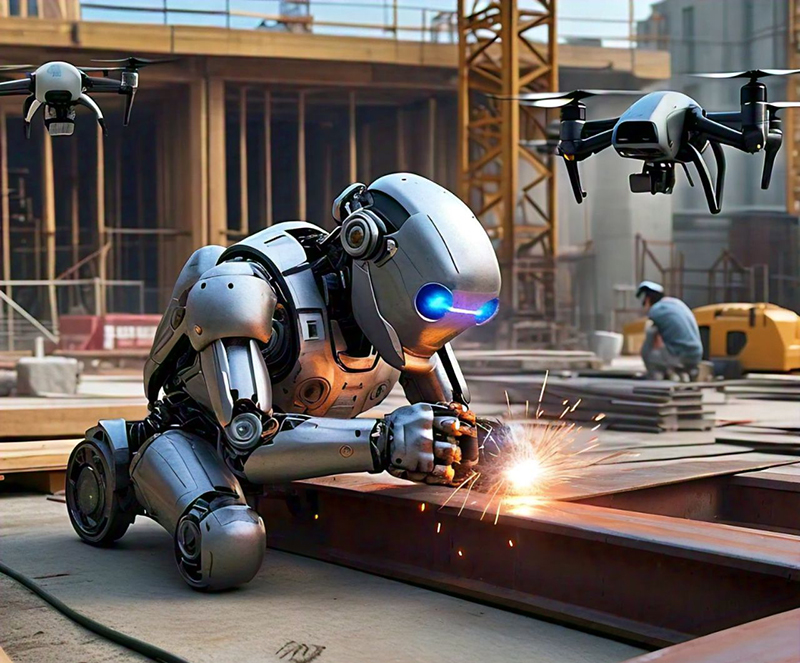
With the rapid advancement of technology, a profound revolution is reshaping the construction industry, driven by robots and artificial intelligence systems. Tasks once considered manual and labor-intensive are now being executed with unprecedented precision and efficiency through programmed mechanical arms that not only mimic human skills but often surpass them.
From digging to painting: Robots at work
The role of robots is no longer limited to simple tasks like lifting bricks or digging; it has expanded to more complex operations such as concrete pouring, roof installation, window fixing, and even painting and welding in hazardous or hard-to-reach environments.
For instance, the American company Built Robotics has developed autonomous systems for excavation equipment, eliminating the need for direct human operation in dangerous work settings and reducing operational costs by up to 30%.
In Australia, Fastbrick Robotics launched its groundbreaking Hadrian X robot, capable of constructing entire walls for a house within just 48 hours. Using artificial intelligence and a highly precise laser guidance system, this innovation almost completely eliminates human error.
Economic and social gains
The direct benefits of robotics in construction are numerous, including shorter project timelines, lower costs, reduced material waste, improved safety standards, and fewer work-related injuries.
In Saudi Arabia, aligned with Vision 2030’s ambition to adopt cutting-edge construction technologies, robots are expected to open new horizons in the real estate sector, especially for large-scale housing projects like The Line in NEOM. Here, construction is anticipated to be almost fully automated, meeting the highest standards of efficiency and sustainability.
Challenges: Cost and social acceptance
Despite these advantages, the robotic revolution faces real challenges. High initial investment costs, lack of integrated digital infrastructure in some markets, and resistance from traditional labor segments fearing job losses to machines are among the primary concerns.
However, this transformation does not necessarily mean the end of the human workforce. It calls for comprehensive retraining programs to equip workers with digital skills, maintenance know-how, programming abilities, and interaction with smart systems — efforts already underway in leading construction markets.
The future of construction: A balance between humans and machines
Ultimately, the rise of robots in construction does not signal the disappearance of human labor but the beginning of a new era of collaboration between humans and machines. Robots don’t tire, don’t sleep, and carry out tasks with utmost accuracy, yet they need humans to program, monitor, and enhance their capabilities.
Take Japan as an example, where robots are used in skyscraper projects to reduce construction time by up to 40%, without fully replacing engineers and site supervisors.
In summary, the construction industry stands at the brink of a robotic revolution. Between faster project delivery, cost reduction, and improved safety, the future looks promising for those who embrace technology as a tool for empowerment rather than replacement.